
AI Engine Optimization is rapidly evolving, influencing how we approach digital marketing. This guide delves into the nuances of Answer Engine Optimization (AEO) and Generative Engine Optimization (GEO), examining their distinct methodologies and overlaps. Understanding these concepts is crucial for maximizing your content’s effectiveness in an AI-driven landscape.
Understanding AI Engine Optimization
Generative Engine Optimization (GEO) plays a critical role in the evolving landscape of digital marketing, specifically within AI Engine Optimization. GEO centers on creating engaging, relevant content that artificial intelligence models favor when producing responses for users. It thrives on understanding user intent and crafting output that resonates with conversational queries. By doing so, GEO aids brands in optimizing their visibility across various AI-driven platforms.
The integration of GEO with existing practices like Answer Engine Optimization (AEO) and Search Engine Optimization (SEO) highlights the complexities of digital marketing. AEO focuses on delivering precise answers to user queries, while SEO aims to improve organic search rankings. Despite differing objectives, both AEO and GEO share a common goal: satisfying user needs. This overlap breeds methodologies that rely on structured data and semantic relevance.
To truly optimize for AI engines, practitioners must embrace techniques such as clear formatting for AI parsing and utilizing schema markup like FAQ schema and HowTo markup. Additionally, creating content that embodies semantic richness ensures relevance, enhancing the overall user experience. Establishing authority and trust through sourcing credibility complements these efforts, aligning well with the E-E-A-T framework.
The advent of AI has spurred a need for diversification in content channels and a broader digital footprint. This calls for branding strategies that leverage unlinked brand mentions, capitalize on long-tail keywords, and encourage user-generated content across platforms like forums and social media. For those keen on learning more about these evolving strategies, this insightful article dives deeper.
Understanding the Basics of AEO and GEO
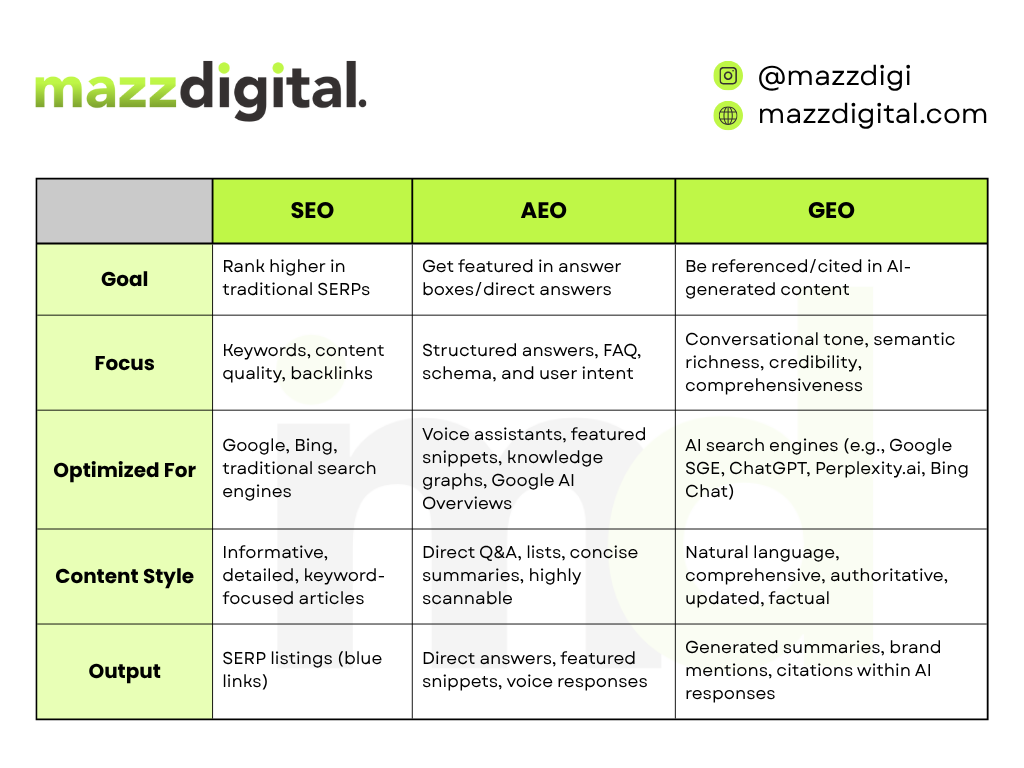
Generative Engine Optimization (GEO) and Answer Engine Optimization (AEO) are game-changers in the digital landscape. GEO focuses on creating content that AI can generate, maintaining a flow that users expect. It’s all about being relevant in the realms of conversational AI and dynamic content creation.
AEO zeroes in on delivering direct answers to users’ queries. Its primary goal is to satisfy user intent swiftly, leaving them enriched with the information they sought. Both GEO and AEO reflect a significant shift as search behaviors evolve. Users now look for precise, often conversational responses rather than lengthy trawls through expansive web pages.
The significance of both optimizations cannot be overstated. They arise in response to the changing nature of search engines and AI technologies. Search engines now leverage machine learning to understand nuances in user intent. With technologies evolving, these optimizations aim to cater to enriched data types, refined content strategies, and engaging formats.
Modern search engines utilize structured data and schema markup, including FAQ and How-To markups, improving the way information is parsed. Emphasizing semantic richness leads to no longer just keyword-stuffed pages but content depth that resonates with AI algorithms.
Adopting AEO and GEO approaches means optimizing for answer-focused content while ensuring credibility through E-E-A-T principles (Experience, Expertise, Authoritativeness, Trustworthiness). This evolving landscape requires marketers and content creators to embrace a hybrid search strategy and adapt continuously.
For those looking to refine their skills, a valuable resource on SEO techniques can be found at this link.
What is Answer Engine Optimization?
Answer Engine Optimization (AEO) is a powerful strategy focused on delivering straightforward answers to user queries. At its core, AEO revolves around the concept of immediacy; users seek quick, easily digestible information. To achieve this, AEO leverages structured data formats, making it easier for AI-driven search engines to parse content efficiently.
Structured data helps delineate different types of information, enhancing the clarity and accessibility of responses. Key elements, such as FAQ schemas, allow webmasters to format questions and answers in a way that AI systems can easily understand. This direct approach not only caters to user intent but also enhances visibility in search results. By delivering concise, relevant answers, websites stand a better chance of being featured in premium placements like featured snippets and knowledge panels.
Additionally, content richness plays a pivotal role in AEO. High-quality content that delves into topics comprehensively appeals to both users and AI engines. It ensures that answers are not merely surface-level but provide depth and context. Incorporating semantic richness and relevant keywords aids in increasing content discoverability. Clear formatting is vital, as AI systems can only parse information efficiently if it’s structured logically.
Emphasizing source credibility cultivates trust with users. Signals of expertise and authoritativeness also boost ranking potential in AI-driven contexts. To keep up with evolving search behaviors, brands must think beyond traditional SEO tactics and embrace AEO’s principles for optimized engagement and visibility. For strategies on improving your website’s SEO while transitioning to future techniques, check this ultimate guide to SEO best practices.
Defining Generative Engine Optimization
Generative Engine Optimization (GEO) is a forward-thinking approach that emphasizes the creation and optimization of content tailored to artificial intelligence’s unique requirements. Unlike traditional methods that often rely on static keywords, GEO harnesses the power of advanced AI technologies, particularly Large Language Model Optimization (LLMO), to generate content that meets user intent more effectively. This approach moves beyond superficial keyword placement, focusing on understanding the complexities of user queries and generating responses that resonate with what users are genuinely seeking.
At its core, GEO utilizes insights from user behavior and intent to craft relevant and engaging content. This reliance on AI not only streamlines content production but also enhances search relevance, elevating the user experience. By recognizing the nuances of conversational queries, GEO effectively addresses the evolving ways people search for information. It prioritizes factors such as semantic richness and content depth, ensuring that the generated materials provide comprehensive answers to users’ needs.
Moreover, clear formatting and structured data play vital roles in GEO, helping AI engines parse and understand the content better. Implementing schema markup, such as FAQ schema or HowTo markup, optimizes information delivery, influencing both search results and user engagement positively. By acknowledging the complexities of modern search behaviors, GEO equips content creators with the tools necessary to thrive in an increasingly AI-driven landscape. For more information on adapting techniques for search engines, check out the insights on best practices for B2B websites.
AEO vs GEO: Different Labels, Same Ideas
Generative Engine Optimization (GEO) and Answer Engine Optimization (AEO) share a common goal: enhancing user experience through focused content. While they might seem different at first glance, digging deeper reveals overlapping principles.
Both GEO and AEO aim to provide users with direct, relevant answers to their queries. GEO focuses on generating high-quality, contextually appropriate content that aligns with user intent. In contrast, AEO prioritizes crafting answers that satisfy specific user questions. The distinctions lie primarily in their methodologies rather than in their objectives.
AEO tends to emphasize concise, answer-focused content, such as FAQs and structured data formats. This allows for seamless visibility in search results, particularly in voice search and AI-driven interfaces. GEO, however, utilizes large language models to enrich content creation, incorporating natural language and generating contextually rich narratives.
Both approaches also leverage structured data and schema markup. These techniques signal search engines to understand content better, allowing for optimization across platforms. By optimizing for AI engines, brands can enhance their visibility and credibility in a rapidly evolving digital landscape.
To succeed, it’s essential to target long-tail keywords and conversational queries. Creating engaging content that resonates with users, strengthens brand presence through unlinked mentions, and establishes authority is the backbone of both strategies. The community’s input through user-generated content can amplify these efforts, making them more impactful. For further insight into optimizing content, consider exploring this guide.
For more insights on digital marketing strategies, visit this comprehensive guide on SEO best practices.
Search Engine Optimization vs Engine Optimization
Generative Engine Optimization (GEO) and Answer Engine Optimization (AEO) mark a shift in how we think about search and AI-driven engines. While SEO revolves around optimizing for traditional search engines, these newer paradigms focus more on understanding user intent and providing accurate, applicable answers.
In the world of SEO, content optimization has always required a deep understanding of keywords and user behavior. However, with the emergence of AI-driven algorithms, the complexity of these interactions increases. Techniques like structured data and schema markup are integral in differentiating content to align it with user intent. By marking up content types—like FAQs or How-to guides—it’s easier for AI to parse and deliver that information quickly.
AEO and GEO both put an emphasis on the quality of content. Voice search and conversational queries are altering how users interact with engines. This means there’s a greater push for content that is not only rich in information but also conversational. The method of becoming recognized as an entity online is essential. This involves integrating aspects of E-E-A-T (Experience, Expertise, Authoritativeness, Trustworthiness) into your digital presence.
As AI continues to evolve, traditional SEO principles need to adapt. Understanding content completeness and relevance can apply to all forms of optimization. By diversifying content channels and embracing community-driven content—like forums and user-generated questions—you’ll enrich your online footprint and prepare for the future of AI-centric search. For an insightful dive into SEO best practices, check out this guide.
Optimizing for AI Engines: Strategies and Best Practices
To optimize for AI engines, creating answer-focused content is essential. This type of content caters specifically to the needs of users, providing concise, relevant answers that align with common queries. Leveraging structured data enhances visibility across AI platforms. Schema markup is a powerful tool to help AI understand the content context better. Implementing formats like FAQ schema, HowTo markup, and Article schema are vital for better results.
Moreover, it’s crucial to understand semantic richness. By enriching your content with related terms, phrases, and nuances, you increase its relevance for conversational queries. AI systems appreciate depth, ensuring your articles don’t just skim the surface. The aim should be for comprehensive articles that satisfy diverse user intents.
Clear formatting also helps in parsing. Utilizing bullet points, short paragraphs, and subheadings can make your content more digestible for AI. Focus on source credibility through link signals, enhancing the E-E-A-T framework—experience, expertise, authoritativeness, and trustworthiness.
Diversifying content channels strengthens your digital footprint across AI engines. Engaging in branding and becoming an entity in your niche creates recognition. Don’t overlook the potential of unlinked brand mentions and user-generated content. Embrace long-tail keywords and conversational queries to capture attention.
Also, ensuring a user-friendly, agent-friendly website enhances your chance of being highlighted in AI-driven searches, making on-site SEO a necessity. Regularly analyze results with web tools, while adapting strategies to match evolving algorithms to stay ahead. For more thoughts on creating optimized content, check out How to Write SEO Optimized Content That Ranks Higher on Google.
Creating Answer-Focused Content
Creating answer-focused content is key when aiming to resonate with AI algorithms. First, let’s explore the need for semantic richness. This refers to how deeply your content connects with the user’s intent. It’s important to include relevant keywords naturally and ensure the context is meaningful. Every paragraph should enhance the understanding of the topic.
Using article schemas can significantly improve how search engines interpret your content. By applying structured data like FAQ schema and How-To markup, you make it easier for AI systems to parse and categorize your content. This enhances visibility in searches, especially for answer-oriented queries.
Content completeness and depth matter, too. Strive to cover topics thoroughly, addressing potential questions and subtopics. Clear formatting helps with AI parsing, ensuring your content is easy to digest. Break up text with headings, bullet points, and visuals to keep readers engaged.
Credibility and trustworthiness are also crucial. Maintain a high E-E-A-T level by sourcing information from reliable references. Include links to authority sites, which signal value to both users and algorithms. Diversifying content across channels enhances your digital footprint and boosts your brand presence.
Long-tail keywords are effective in capturing conversational queries, making your content more agent-friendly. Encourage user-generated content, as this not only enriches the community but may also lead to brand mentions that drive traffic.
For more insights on SEO best practices, check out this guide.
Branded vs Unlinked Mentions and Their Impact
Entity optimization plays a critical role in enhancing both Answer Engine Optimization (AEO) and Generative Engine Optimization (GEO). A well-recognized entity has a significant advantage in visibility across various AI-driven search platforms. Unlinked brand mentions serve as a powerful factor in shaping search performance. While they may not directly contribute to traditional backlinks, they still increase awareness and credibility.
To become a recognized entity, brands should prioritize consistent messaging across channels. This helps establish a strong identity, which search engines can easily recognize and categorize. Engaging with users through various platforms, like social media and forums, allows for organic unlinked mentions. These informal references contribute to entity recognition, signaling relevance and authority to AI systems.
Additionally, brands should focus on creating high-quality content that resonates with audiences. This includes answer-focused content that directly addresses user intent. Structured data and schema markup can enhance content visibility, becoming vital assets in entity optimization. Consider implementing FAQ schema or Article schema that guide search engines in understanding context and purpose.
Combining these strategies not only improves brand visibility but also sets up a framework for higher relevance in AEO and GEO contexts. Adopting a comprehensive approach that integrates brand mentions, strategic content, and structured data will ensure optimal performance in an increasingly AI-driven digital landscape. To learn more about optimizing content for search engines, check out this guide.

Leveraging Emerging Technologies in Your Strategy
As AI tools increasingly influence online strategies, adapting to these changes is essential. Tools like conversational agents and AI-driven search platforms are redefining how users seek information. Embracing generative and answer engine optimizations is crucial for staying ahead.
The focus on creating content that resonates with user intent is paramount. To appeal to AI, it’s important to think about how the algorithms process information. For instance, conversational queries often lead users to direct answers rather than traditional browsing. By crafting answer-focused content, brands can make their information more accessible to AI engines.
Utilizing structured data and schema markup allows search engines to better understand your content. Markups such as FAQ and HowTo can significantly enhance your chances of appearing in featured snippets or knowledge graphs. This makes it easier for AI to parse your content effectively, thereby increasing visibility.
Moreover, ensuring your content is credible builds trustworthiness. Following the E-E-A-T guidelines—Experience, Expertise, Authoritativeness, and Trustworthiness—can significantly enhance your brand perception in the eyes of AI algorithms. Diverse content channels such as forums and user-generated content also play a role in boosting your digital footprint.
Tools to analyze site speed and structure help optimize the user experience. Fast-loading websites with clear navigation improve engagement with both users and AI. With algorithms evolving, understanding user behavior is essential. Adapting to a new landscape where community-driven content plays a role can amplify your AI strategy. For more insights on crafting SEO-optimized content, visit this guide.
Building a Hybrid Search Strategy
Developing a hybrid search strategy is vital for businesses looking to optimize their online visibility comprehensively. This strategy fuses traditional SEO with the newer concepts of AEO and GEO, acknowledging the shifts brought on by AI-driven technologies. By diversifying their digital footprint, companies can capture a broader audience across different platforms.
Firstly, businesses should understand the importance of answer-focused content. Creating structured data with schema markup—such as FAQ schema or HowTo markup—helps search engines better understand the content. This structured formatting increases the chances of appearing in featured snippets or knowledge graphs, which are crucial for zero-click searches.
Additionally, optimizing for AI engines extends beyond just textual content. It involves enhancing the site’s speed, structure, and user experience. Clear formatting for AI parsing ensures that search algorithms easily interpret the information. It’s also wise to track source credibility and link signals, reinforcing the site’s E-E-A-T (Experience, Expertise, Authoritativeness, Trustworthiness).
Investing in unlinked brand mentions and using long-tail keywords can capture conversational queries, thereby catering to various user intents. Engaging with user-generated content from platforms like forums can foster a community around the brand, enriching the online presence.
Lastly, businesses should consider versatile content channels. Press releases, web apps, and other tools can add value and drive traffic. Embracing agent-friendly features will improve interactions with voice assistants and other AI formats, thus expanding reach and engagement. For further insights on optimizing your digital strategy, explore best practices for B2B websites.
Evaluating Success and Future Trends
Evaluating success in AEO and GEO strategies hinges on several critical metrics. Key performance indicators (KPIs) include organic traffic growth, engagement rates, and conversion rates. Monitoring how these metrics change over time can help digital marketers gauge the effectiveness of their strategies. Engagement metrics like time on page and bounce rates reveal user interest and satisfaction. Additionally, tracking zero-click searches or featured snippets can provide insights into visibility, showing how well content addresses user queries.
In light of evolving search behaviors, future trends in AI and search optimization promise to reshape strategies. Watch for advancements in generative AI capabilities, which could lead to more personalized user experiences. The growth of voice search and conversational queries will necessitate a shift towards optimizing for voice assistants. Adapting to these changes means focusing on long-tail keywords and crafting conversational content.
Another trend centers on entity optimization. Becoming an entity in the eyes of search engines can enhance credibility and authority. This requires not just content creation but also fostering unlinked brand mentions across platforms. Diversifying content channels and focusing on user-generated content will also become increasingly important for building an engaged audience.
Marketers should also consider utilizing tools for site speed and structure to optimize the user experience. As AI continues to disrupt the digital landscape, understanding these metrics and trends will be crucial for staying ahead. For more insights, check out this guide on optimizing SEO strategies.
Conclusion and Next Steps
Understanding the nuances of Generative Engine Optimization (GEO) and Answer Engine Optimization (AEO) is essential for modern digital marketing strategies. As the landscape shifts towards AI-driven algorithms, recognizing how these optimizations impact SEO can be game-changing. AEO focuses on delivering precise answers to user queries, while GEO prioritizes content creation techniques that cater to generative models. Both approaches overlap significantly, yet they serve different strategic purposes.
When deploying optimization strategies, ensure your content is answer-focused. This involves structuring data using schema markup such as FAQ schema or HowTo markup to enhance search engine comprehension. To enrich user experience, prioritize content completeness, depth, and semantic relevance. Utilize clear formatting for AI parsing and emphasize source credibility.
It’s equally important to diversify your content channels. An agent-friendly website is conducive to improved interaction with voice assistants and chatbots. Incorporating user-generated content, like discussions on forums, can also enhance engagement and authority. Monitoring AI brand presence through analytics tools enhances the overall effectiveness of your strategy.
Consider long-tail keywords and conversational queries to align with changing search behaviors. These tactics help in recognizing user intent, allowing for a more adaptive approach to SEO. By focusing on these nuances, businesses can craft a hybrid search strategy that drives conversions while nurturing the community. For further insights, visit this guide to best SEO practices.



Comments are closed.